Salzman Services builds paver patios, seating walls, fire pits, and walkways in Union Pier, MI. A lot of the homes here are rentals or weekend places on compact village lots, and all of them sit on loose dune sand over a water table that rises with every storm off the lake. We've built in Union Pier before, we work throughout Chikaming Township and Harbor Country, and where a project falls under Michigan's dune protections we plan for those rules from the start.
Paver Patios in Union Pier, MI
Union Pier lots are small, and the patios on them get worked hard, especially on the rental properties that turn over every weekend all summer. The ground doesn't help. Loose dune sand shifts and migrates, the water table sits high, and a patio built the standard way settles into low spots and heaves loose within a few winters. Keeping one flat here comes down to the base.
What's under the patio
We dig down at least 11 inches to clear the loose sand near the surface. The whole excavation gets lined with non-woven geotextile fabric. On a sand lot that fabric isn't optional: without it, fine sand works its way up into the base and the patio slowly sinks. Over the fabric we compact 8 inches of open-graded clean stone (ASTM No. 57), which locks together but leaves voids throughout, so lake-driven groundwater passes straight through instead of collecting under the pavers and lifting them in a freeze.
Finished for rental turnover
If your place hosts a rotating cast of guests, the patio has to look clean at every changeover without anyone tending it. So the joints get polymeric sand that sets firm, keeps out weeds and ants, and rides out freeze-thaw. The perimeter gets a buried concrete bond beam instead of plastic edging that heaves up and looks cheap. And if you think you'll want string lights or speakers someday, say so before we build; we can run conduit sleeves through the base so it's an easy add later.
Making a small lot feel bigger
The trick on a village lot is making a modest footprint feel like a real outdoor room instead of a leftover strip of yard. We lay out defined spots for the table, the grill, and the lounging edge so the space works for a full rental group without feeling crammed. On tight properties we bring materials in by hand or with compact equipment, so we're not wrecking the rest of the yard to build the patio. You can see more of this work on our paver patios page.
Seating Walls in Union Pier, MI
On a compact Union Pier lot, a seating wall earns its spot fast: it seats a whole rental group without eating the floor space chairs would. And there's nothing to store, replace, or chase across the lawn in a lake wind. Built low around a patio edge or wrapped around a fire, it's what makes a small yard hold a crowd. We build them at real sitting height and depth, match the block and cap to the cottage, and can run low-voltage LED along the cap so guests can find their footing after dark.
A footing that holds in sand
The same sand that undermines patios undermines walls, so we don't stack block on the ground. The wall gets the drained base from the patio section above, carried below the frost line, with the courses bonded and the caps glued down. That matters when the people using it are guests who don't know to be gentle with it.
When the wall has to hold back the yard
Some lots here, especially closer to the water or against a wooded rise, need a true retaining wall to hold a slope and level out usable ground. We build those with a full drainage package behind them: clean stone wrapped in filter fabric that bleeds off the water pressure sand and rain build up, which is the force that tips walls built without it. Where a wall sits near the shoreline, Michigan's dune rules come into play and we account for them. If you're not sure whether your lot needs a seat wall or a retaining wall, we'll tell you plainly at the estimate. More detail lives on our retaining walls page.
Fire Features in Union Pier, MI
On a rental, a fire pit is one of the few backyard features that directly earns money. It's in the listing photos, it's why a September weekend still books, and it's where every group ends up after the beach. We build permanent gas and wood-burning fire pits in Union Pier that survive the two things that kill cheap ones on this shore: sand and hard use.
Built for the ground and the heat
Masonry is heavy, and heavy things sink in loose dune sand. A pit set straight on the ground cracks and tilts within a couple of seasons. Ours sit on the same drained base as our patios. Heat is the other problem: open flame against raw masonry cracks it, so we line every pit with a heavy-gauge 304 stainless or Corten steel insert that takes the thermal shock instead of the stone. The top edge, where everyone rests drinks and feet, gets set with high-strength adhesive.
Smoke, and the gas-or-wood question
Lake breeze pushes smoke around the circle, so if that's the complaint, we can build a smokeless insert like a Breeo into the masonry. It re-burns the smoke before it leaves the pit. On fuel, gas usually wins for a rental: it lights instantly, shuts off clean, and leaves no ashes for the next guests or the turnover crew. Wood makes sense for an owner who wants the full bonfire for big summer weekends. We run the gas line as part of the build, and either way it's a permanent build with proper clearances, not a kit dropped on the sand. There's more on our main fire pits page.
Paver Walkways in Union Pier, MI
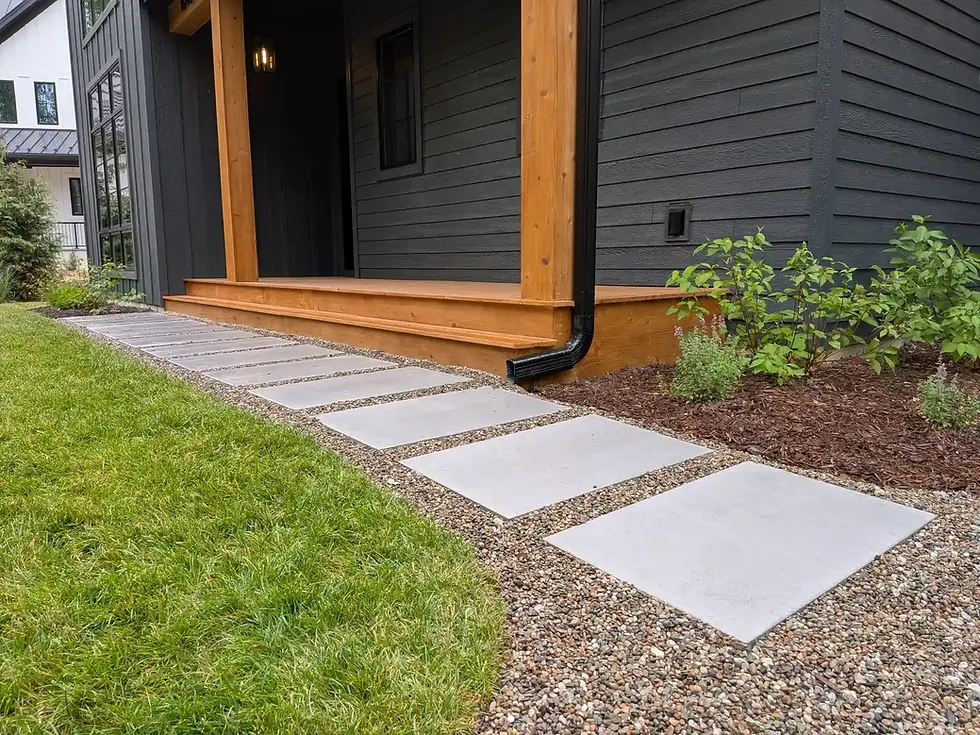
Union Pier is a walking village. Guests go on foot to Townline Beach, to the bakery, to Union Pier Social, and back to the house with sandy towels and a week's worth of gear. The paths on a property here take more traffic than the driveway does. A firm paver walk along those routes keeps the sand and mud off the lawn and out of a rental that has to be clean by Friday, and it's work we've done here.
Routing and width
We build main entry paths at least 48 inches wide, enough for two people to pass while hauling coolers and beach bags. Then we map the rest of the routes people actually walk: driveway to door, side yard to backyard, and the worn line toward the beach that takes the heaviest traffic. We match the pavers to the cottage and any patio so the property reads as one design.
Why the base and grade matter on sand
A walkway laid loose on dune sand settles into ruts as the ground shifts, and it drains badly, so it puddles after a lake storm and glazes over in the cold months. Ours go down on a compacted, contained base with a deliberate pitch that sheds water to the side. And we use pavers instead of poured concrete for a simple reason: freeze-thaw cracks concrete near the lake, and a cracked slab is a full replacement. A stained or chipped paver gets lifted and swapped one stone at a time, which on a busy rental path will happen sooner or later. There's more on our main paver walkways page.
Hardscape Restoration in Union Pier, MI
A lot of Union Pier hardscapes were built fast, by whoever was cheapest, for an owner who wasn't around to watch the work. A few winters later we get the call: a sunken patio section, a walkway with a lip, a fire pit leaning in the sand, pavers gone gray and weedy while the house sat empty between guests. Most of it doesn't need to be torn out. It needs the actual cause found.
What went wrong under there
Nearly every structural failure we see here is the same one: the surface was laid straight on the dune sand with no separation fabric and no draining base, so the sand migrated and the surface followed it down. That's a specific, fixable problem, not a mystery. The rest is cosmetic wear from lake exposure: color bleached by sun and blowing sand, joints eroded and sprouting weeds, moss where nothing was sealed for years. Those are very different repairs at very different prices, and we'll tell you at the estimate which one you've got.
Three levels of repair
Clean, re-sand and seal. Structure's fine, looks are gone. Deep clean, pull the efflorescence haze before sealing, fresh polymeric sand, and a sealer that brings the color back. The fastest way to make a rental photograph well again.
Lift and re-lay. One area settled. We pull just those pavers, correct the base under them, and reset the original stones.
Full rebuild. When the base has failed everywhere, patching buys a season at best. We strip it and rebuild to our new-install standard.
Leaning walls and staying ahead of it
A leaning wall here is a drainage problem: saturated sand builds pressure behind a wall that was never given a way to drain. We dig out behind it and install clean drain stone and perforated pipe so the pressure has somewhere to go, instead of just re-stacking a wall that will move again. After that, reseal every three to five years. When water stops beading on the pavers and starts soaking in, it's time. There's more detail on our hardscape restoration page.
Stone Overlays in Union Pier, MI
If your Union Pier cottage has a concrete porch or patio slab that's solid but dated, an overlay is the fast fix. Instead of tearing out and repouring, which means noise, mess, and lost rental weekends, we face the existing slab with natural stone, pavers, or outdoor porcelain. The gray concrete disappears, and the job turns around in days, not weeks.
First question: is the slab worth keeping?
An overlay only works over concrete that's still sound: flat, stable, not cracked or lifting. If the sand has already undermined and heaved your slab, covering it just hides the problem until the next freeze finds it. That's a restoration job instead, and we'll tell you which one you're looking at before we quote anything.
Built so the lake can't lift it
Water expands about 9% when it freezes, and moisture trapped between old slab and new stone will shear an overlay loose in one winter. So we grind the slab so the mortar has a real physical grip, and set the stone in polymer-modified structural mortar that flexes with seasonal movement. Then we build drainage in: open channels under the border stones and a fabric-and-sand bed under the field, so water that reaches the slab gets out. We wrap the step faces and edges in matching stone so no concrete shows anywhere, and the finished porch reads as solid stonework. On a rental, the whole thing can slot between booked weekends. There's more on our main stone overlays page.