Union Pier is Harbor Country at its most walkable—a compact village where cottages sit a short stroll or bike ride from Townline Beach, Union Pier Social, and the downtown coffee-and-bakery cluster, and where a huge share of the homes turn over as summer rentals. That setting shapes what a backyard needs to do here: handle constant sandy foot traffic, look sharp for the next set of guests, and stay low-maintenance for owners who are only around on weekends. It also sits on classic lakeshore ground—loose, shifting dune sand over a water table that rises with every storm off the lake—which quietly destroys hardscapes that were not built for it. Salzman Services builds for these exact conditions: paver patios, seating walls, walkways, and fire features engineered on deep, free-draining foundations that stay level through sand and freeze-thaw. We have completed projects here in Union Pier, we work throughout Chikaming Township and the wider Harbor Country shoreline, and because much of this area falls under Michigan's regulated dune protections, we build with those shoreline rules in mind from the first sketch.
Paver Patios in Union Pier, MI
On a Union Pier lot, the patio is where the rental weekend actually happens—coffee from the village in the morning, drinks after the beach, dinner outside before everyone walks back down to the water. These are not sprawling estate yards; they are compact village lots where the outdoor space has to be smart, durable, and effortless. The threat to all of it is the ground underneath. Union Pier's loose dune sand shifts and migrates, and with the lake's water table sitting high beneath it, a patio built the standard way settles into low spots, pools water, and heaves loose within a few winters. We build so the sand stays where it belongs and the surface stays dead level.
Where the durability actually comes from
The work that makes a lakeshore patio last is all below the surface. We dig down at least 11 inches to clear the loose organic sand and reach ground we can build on, then lay a full separation layer of non-woven geotextile fabric between that native sand and everything above it. On a sand lot this fabric is non-negotiable: without it, fine sand migrates up into the base and the patio slowly sinks: with it, the two layers stay separate for good. Over the fabric we compact 8 inches of open-graded clean stone (ASTM No. 57), an angular aggregate full of open voids that lets lake-driven groundwater pass straight through instead of collecting under your pavers and lifting them when it freezes.
Made for rental turnovers and weekend owners
Because so many Union Pier homes host a rotating cast of guests, we finish every patio to shrug off heavy use with near-zero upkeep. We lock the joints with polymeric sand that sets firm, keeps weeds and ants out, and survives freeze-thaw, so the surface still looks clean at every changeover without anyone tending it. We anchor the perimeter with a hidden reinforced concrete bond beam instead of plastic edging that heaves up and looks cheap. And we run PVC conduit sleeves through the base before the pavers go down, so string lighting or speakers can be added later without tearing anything up—useful on a property you are always making a little more guest-ready.
Sized for a village lot, designed as a room
The trick on Union Pier's smaller lots is making a modest footprint feel like a genuine outdoor room rather than a leftover strip of yard. We design around the way the space is really used—the walk in from the door, room for a table that seats the whole rental group, a lounging edge that does not crowd the grill—and lay it out in defined zones so a compact patio still feels intentional and generous. On tight village properties we bring materials in by hand or with compact equipment so we can build a first-rate patio without wrecking the surrounding yard to get to it. The finished space drains fast, ignores the sand, and looks ready for guests season after season.
Seating Walls in Union Pier, MI
On a compact Union Pier lot, a seating wall earns its keep in a way it never has to on a big estate yard: it adds real seating without eating the floor space a table and chairs would. Built low around the edge of a patio or wrapped by a fire, it seats a full rental group, doubles as a low retaining edge where the yard steps down, and never has to be dragged out of a shed or blown across the lawn in a lake wind. It is the piece that makes a small outdoor space work for a crowd. The catch is that the same dune sand that undermines patios undermines walls—so a seat wall here has to be built on a real foundation, not stacked on the ground.
Seating that does double duty on a small lot
We build seat walls at genuine sitting height and depth so they are comfortable for an evening, not just ornamental, and we lay them out to solve the specific lot. Ringing a fire, a low wall makes a tight gathering space that keeps everyone close on a cool shoreline night. Along a patio edge, it defines the room and quietly separates lounging from dining where there is not much square footage to spare. Where a village lot drops a foot or two, the same wall doubles as a low retaining edge that levels a usable spot. We match the block and cap to the cottage and work in low-voltage LED lighting along the cap where it helps guests find their footing after dark.
A footing that holds in shifting sand
A wall that gets sat on for years cannot sit on loose sand, so we build the base the way we build it under a patio: excavated down past the loose material, separated from the native dune sand with non-woven geotextile, and set on compacted open-graded stone that drains instead of holding water against the wall. That free-draining footing, carried below the frost line, is what stops the seasonal freeze-thaw from lifting the wall and popping its caps loose over a few winters. We bond the courses and set the caps with high-strength adhesive so nothing shifts underfoot, even with constant use from guests who do not know to be gentle with it.
When the wall has to hold back the yard
Some Union Pier lots, especially those closer to the water or tucked against a wooded rise, need more than a seat wall—they need a true retaining wall to hold a slope or carve a flat, usable area out of a grade. We build those with a full drainage system behind them, clean stone wrapped in filter fabric that bleeds off the water pressure sand and rain build up behind a wall, which is the force that eventually tips an unengineered one. And because this stretch of shoreline falls under Michigan's dune protections, we account for those rules when a wall sits near the lake. Seat wall, retaining wall, or a tiered mix, we will tell you plainly what your lot actually calls for.
Fire Features in Union Pier, MI
In a rental-heavy village like Union Pier, a fire feature is one of the highest-value things a backyard can have. It is the photo that books the summer weekend, the spot everyone gathers after a day at Townline Beach, and the reason a shoulder-season stay still feels worth it when the lake wind turns cool. For an owner, it is an amenity that pays for itself in bookings and repeat guests. For it to do that job, though, it has to be built to survive a sand lot and constant, not-always-careful use—which is exactly where drop-in kits and quick installs fail.
Why a sand lot punishes a cheap fire pit
A masonry fire feature is heavy, and heavy things sink in loose dune sand that shifts as it wets and dries. Set one straight on the ground and it cracks and tilts within a couple of seasons. We build ours on the same engineered base as our patios—excavated, separated from the sand with geotextile, and set on compacted open-graded stone that keeps it level and lets groundwater drain away instead of freezing beneath it. Just as important is heat: an open flame against raw masonry cracks it, so we line our fire pits with a heavy-gauge 304 stainless or Corten steel insert that takes the thermal punishment and protects the stone, and we set the top edge with high-strength adhesive so it survives years of people resting drinks and feet on it.
Less smoke, more shoulder season
Smoke is the fastest way to end a good evening, and it is worse on an open lakeside lot where the breeze pushes it around the circle. We build in smokeless technology—double-wall convection units such as Breeo—that re-burn the smoke before it escapes, giving guests the warmth without the sting. Paired with the shelter of a curved seat wall on the windward side, a fire feature keeps a Union Pier yard usable well past Labor Day, which for a rental is extra weeks of booking calendar rather than a backyard that closes with the season.
Gas for guests, wood for the crowd
For a rental or a weekend place, gas usually wins on practicality—it lights instantly, shuts off clean, and leaves no ashes for the next guests or the turnover crew to deal with, and we run and connect the gas line as part of the build. For an owner who wants the full bonfire feel for big summer gatherings, a wood-burning pit brings the crackle and the scale. Either way we build it as a permanent, engineered feature on a proper base with the right non-combustible clearances—not a kit dropped on the sand—so it stays safe and looks intentional for years of Union Pier summers.
Paver Walkways in Union Pier, MI
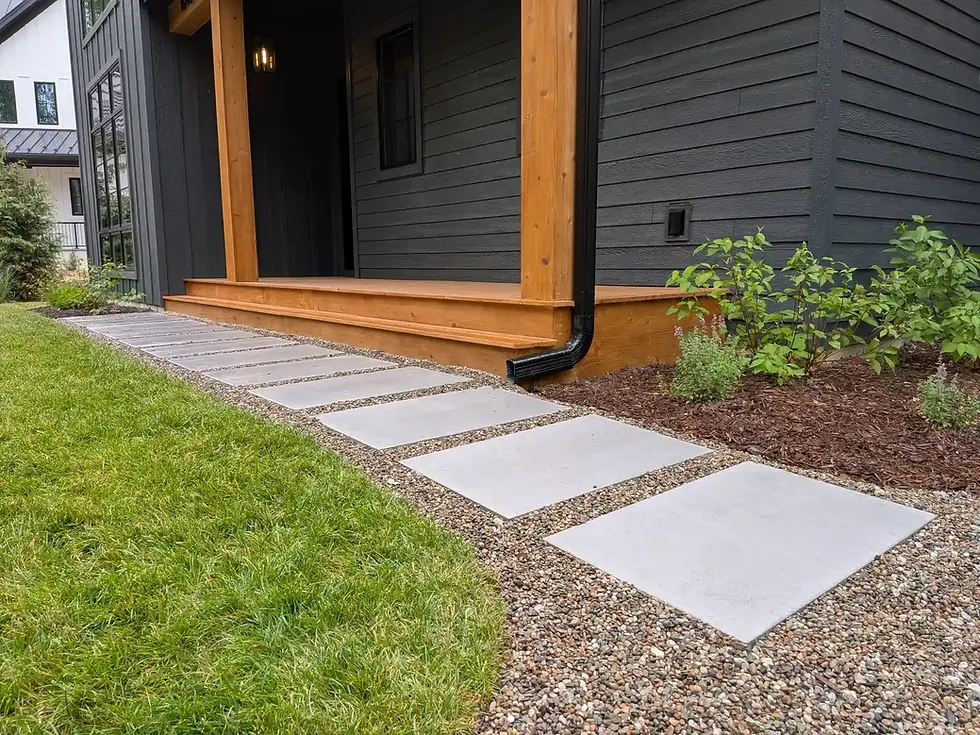
Walkways may be the single most important hardscape in Union Pier, because this is a village built for walking. Guests move on foot constantly—house to Townline Beach, house to the bakery and Union Pier Social, car to door with a weekend's worth of bags and sandy towels. A solid, well-planned path is what keeps that traffic off the lawn and the sand out of the cottage, and it is genuinely the kind of work we have completed here. A muddy worn track or a cracked concrete strip, by contrast, is the first thing an arriving guest notices. We build paths designed for how people actually move through a Union Pier property.
Built for the walk to the beach and back
We plan a walkway around the real routes on your lot—the approach from the driveway to the door, the side path to the backyard, and the well-worn line toward the beach or the village that takes the most sandy-footed traffic. For a main entry we build to a minimum 48-inch width so two people can pass comfortably, which matters when guests are hauling coolers and beach gear. A firm paver path along the heavy routes keeps sand and mud from getting tracked across the grass and into a rental that has to be clean for the next arrival—turning a constant sweeping chore into a non-issue. We tie the paths visually to the cottage and any patio so the whole property reads as one considered design.
Drainage and footing on sandy ground
On dune sand, a walkway that is not built and graded correctly does two things wrong: it settles into a rutted, uneven trip hazard as the sand shifts beneath it, and it channels water poorly so puddles or slick spots form after a lake storm. We build the path up on a proper compacted, sand-separated base and set it on a gentle, deliberate pitch so it stays level underfoot and sheds water cleanly to the side rather than pooling. That base work is why our paths hold their line on ground that swallows walkways laid the lazy way.
Why pavers, not poured concrete, on the shore
Poured concrete is the wrong material this close to the lake: the freeze-thaw cycle cracks it, and once it cracks the whole slab is a repair. Our interlocking pavers flex with the ground's seasonal movement instead of fracturing, and if a single stone is ever chipped or stained—wholly likely on a busy rental path—we lift that one paver and swap it, an invisible fix concrete cannot match. Polymeric-locked joints keep the whole path tight, weed-free, and low-maintenance through the seasons an owner is away. The result is an entrance and a beach path that still look sharp after years of sandy, constant Union Pier foot traffic.
Hardscape Restoration in Union Pier, MI
A lot of Union Pier hardscapes were built fast, by whoever was cheapest, for an owner who was not going to be around to watch the work—and it shows a few winters later. Sunken patio sections, a walkway that has developed a lip, faded and weed-choked pavers, a fire pit leaning in the sand: these are the calls we get here. The good news is that most of it does not need to be torn out and started over. It needs the real cause found and fixed. Before we quote any Union Pier restoration, we read the base, not just the surface, because on a sand lot the surface is almost never the actual problem.
What actually went wrong under there
Nearly every structural failure we see in Union Pier traces to a base that never accounted for the sand. When a patio or path is sinking or has gone wavy, it is because it was laid straight on the dune sand with no separation fabric and no draining stone base—so the sand migrated, washed, and shifted until the surface followed it down. That is a specific, fixable diagnosis, not a mystery.
The other half of what we see is purely cosmetic and comes from lake exposure: color bleached by sun and wind-driven sand, joints eroded and sprouting weeds, moss and grime on a surface no one sealed or maintained while the house sat empty between guests. We handle both—and we tell you honestly at the estimate which one you have, so you are not paying to rebuild something that only needs a refresh.
Matching the repair to the real problem
Clean, re-sand and seal. For a sound surface that just looks tired: a deep clean to strip grime, moss and dead joint material, an efflorescence treatment to pull the white haze before sealing, fresh polymeric sand, and a premium sealer that restores color and shields against sun, sand abrasion and stains—the fastest way to make a rental photograph well again.
Targeted lift and re-lay. For a single settled or heaved area: we pull just those pavers, rebuild the base beneath them with the geotextile and draining stone the sand demanded from day one, and reset the original stones—killing the dip and the trip hazard without redoing the whole surface.
Full rebuild. When the base has failed across the whole hardscape, patching only buys a season. We strip it out, reconstruct the foundation to our new-install standard, and relay it right.
Leaning walls and staying ahead of it
A leaning or bulging wall on a Union Pier lot is a drainage problem: water and saturated sand build pressure behind a wall that was never given a way to drain, and that pressure pushes it over. We dig out behind it and install clean drain stone and perforated pipe to relieve that pressure, fixing why it moved rather than just re-stacking it. Once anything is put right, a reseal every three to five years keeps the lake from undoing it—when water stops beading and starts soaking in, that is the signal to reseal before another round of sun and sand takes its toll.
Stone Overlays in Union Pier, MI
If your Union Pier cottage has a concrete porch or patio slab that is solid but dated, an overlay is the fastest way to modernize it—which matters a great deal on a property you rent or only get to enjoy on weekends. Rather than the noise, mess, and lost bookings of tearing out and repouring concrete, we clad the existing slab in natural stone, architectural pavers, or outdoor porcelain, and the tired gray surface simply disappears under a high-end finish. For a rental, it is a look-upgrade that turns over in days, not weeks, with no demolition to schedule around guests.
First question: is the slab worth keeping?
An overlay is a surface treatment, so it only works over concrete that is genuinely sound—flat, stable, and not already cracked or lifting. This is the honest dividing line between an overlay and restoration: an overlay dresses up good concrete, while a slab the sand has already undermined and heaved is a base problem that belongs in our restoration process instead. We make that call up front and tell you straight which one your slab is, because cladding a failing slab just hides the problem until the next freeze finds it.
Bonding stone to concrete so the lake can't lift it
Near the shore, the enemy of an overlay is trapped moisture. Water expands about 9% as it freezes, so any moisture caught between the old slab and the new stone will shear the overlay loose in one winter. We beat that two ways. For grip, we skip the shortcut of adhesive alone and mechanically grind or scarify the slab to open its surface, then set the stone in ANSI-rated, polymer-modified structural mortar whose latex content lets the bond flex slightly with seasonal movement instead of cracking. For water, we build a hybrid drainage detail—perpendicular adhesive channels under the border stones plus a geotextile-and-sand bed under the field—so any moisture that reaches the slab escapes rather than freezing under your new surface. On a humid lakeshore lot, giving that water an exit is the whole game.
A finish with no concrete left showing
A proper overlay hides every trace of the slab, verticals included. We clad the step faces and landing edges with matching stone risers so the old concrete vanishes and the finished porch reads as solid, built-from-scratch stonework rather than a facing laid over a slab. We match the material to the cottage and to any other hardscape on the lot, and where the work sits near the shore we keep Michigan's dune-area rules in mind. The payoff is a fresh, high-end entrance delivered fast enough to slot between rental weekends—no jackhammers, no dumpster, no lost season.